The following object is masked from 'package:terra':

    shift
require(metafor)
Loading required package: metafor
Loading required package: Matrix
Loading required package: metadat
Loading required package: numDeriv
Loading the 'metafor' package (version 4.8-0). For an
introduction to the package please type: help(metafor)
# empty environmentrm(list=ls())# load in cropland area Copernicus (not used)if(FALSE){# source: https://www.esa-landcover-cci.org/?q=node/164) cropland <- terra::rast('data/cropland83km_v2.tif') cropland.dt <-as.data.table(cropland)setnames(cropland.dt,'cci_croptype')# describe crops cropland.dt[cci_croptype ==10, ctype :='rainfed_cropland'] cropland.dt[cci_croptype ==20, ctype :='irrigated_cropland'] cropland.dt[cci_croptype ==30, ctype :='mosaic_cropland'] cropland.dt[cci_croptype ==40, ctype :='natural_vegetation'] }require(terra)require(data.table)require(metafor)# Luncheng add# read the raster with climatic data r.clim <- terra::rast('data/climate.tif')# read the raster with cropping data r.crop <-rast('data/ma_crops.tif')# read the raster with soil data r.soil <- terra::rast('data/soil.tif')# read the earlier prepared file with tillage practices r.till <- terra::rast('data/tillage.tif')# read the earlier prepared file with manure N dose r.nman <- terra::rast('data/nofert.tif')# read the earlier prepared file with fertilizer N dose r.nfert <- terra::rast('data/nifert.tif')# read the earlier prepared file with cropping intensity r.cropint <- terra::rast('data/cropintensity.tif')########################################################################## add all rasters# clear environmentrm(list=ls())# what rasters are in data rfiles <-list.files('data', pattern ='tif$',full.names =TRUE) rfiles <- rfiles[!grepl('cropland|climzone|soc',rfiles)]# read in raster files r.ma <- terra::sds(rfiles)# convert to raster r.ma <- terra::rast(r.ma)# convert rasters to data.table# set first to xy data.frame (NA=FALSE otherwise gridcels are removed) r.df <-as.data.frame(r.ma,xy =TRUE, na.rm =FALSE)# convert to data.table r.dt <-as.data.table(r.df)# setnamessetnames(r.dt,old =c('climate_mat', 'climate_pre','soil_isric_phw_mean_0_5','soil_isric_clay_mean_0_5','soil_isric_soc_mean_0_5','nifert_nfert_nh4','nifert_nfert_no3','nofert_nofert','cropintensity_cropintensity'),new =c('mat','pre','phw','clay','soc','nh4','no3','nam','cropintensity'),skip_absent = T)# select only land area r.dt <- r.dt[!(is.na(mat)|is.na(pre))] r.dt <- r.dt[!(is.na(tillage_RICE) &is.na(tillage_MAIZ) &is.na(tillage_other) &is.na(tillage_wheat))] r.dt <- r.dt[!(is.na(ma_crops_RICE) &is.na(ma_crops_MAIZ) &is.na(ma_crops_other) &is.na(ma_crops_wheat))]# replace area with 0 when missing cols <-colnames(r.dt)[grepl('^ma_|nh4|no3|nam',colnames(r.dt))] r.dt[,c(cols) :=lapply(.SD,function(x) fifelse(is.na(x),0,x)),.SDcols = cols] cols <-colnames(r.dt)[grepl('^tillage',colnames(r.dt))] r.dt[,c(cols) :=lapply(.SD,function(x) fifelse(is.na(x),1,x)),.SDcols = cols] r.dt[is.na(cropintensity), cropintensity :=1]# melt the data.table r.dt.melt <-melt(r.dt,id.vars =c('x','y','mat', 'pre','phw','clay','nh4','no3','nam','soc','cropintensity'),measure=patterns(area="^ma_crops", tillage ="^tillage_"),variable.factor =FALSE,variable.name ='croptype')# set the crop names (be aware, its the order in ma_crops) r.dt.melt[,cropname :=c('rice','maize','other','wheat')[as.numeric(croptype)]]# set names to tillage practices r.dt.melt[, till_name :='conventional'] r.dt.melt[tillage %in%c(3,4,7), till_name :='no-till']# derive the meta-analytical model# read data d1 <- readxl::read_xlsx('Source Data.xlsx',sheet ="Figure4") d1 <-as.data.table(d1)# add CV for NUE treatment and estimate the SD for missing ones d2<-d1 CV_nuet_bar<-mean(d2$nuet_sd[is.na(d2$nuet_sd)==FALSE]/d2$nuet_mean[is.na(d2$nuet_sd)==FALSE]) d2$nuet_sd[is.na(d2$nuet_sd)==TRUE]<-d2$nuet_mean[is.na(d2$nuet_sd)==TRUE]*1.25*CV_nuet_bar CV_nuec_bar<-mean(d2$nuec_sd[is.na(d2$nuec_sd)==FALSE]/d2$nuec_mean[is.na(d2$nuec_sd)==FALSE]) d2$nuec_sd[is.na(d2$nuec_sd)==TRUE]<-d2$nuec_mean[is.na(d2$nuec_sd)==TRUE]*1.25*CV_nuec_bar# clean up column namessetnames(d2,gsub('\\/','_',gsub(' |\\(|\\)','',colnames(d2))))setnames(d2,tolower(colnames(d2)))# calculate effect size (NUE) es21 <-escalc(measure ="MD", data = d2,m1i = nuet_mean, sd1i = nuet_sd, n1i = replication,m2i = nuec_mean, sd2i = nuec_sd, n2i = replication )# convert to data.tables d02 <-as.data.table(es21)# what are the treatments to be assessed d02.treat <-data.table(treatment =c('ALL',unique(d02$management)))# what are labels d02.treat[treatment=='ALL',desc :='All'] d02.treat[treatment=='EE',desc :='Enhanced Efficiency'] d02.treat[treatment=='CF',desc :='Combined fertilizer'] d02.treat[treatment=='RES',desc :='Residue retention'] d02.treat[treatment=='RFP',desc :='Fertilizer placement'] d02.treat[treatment=='RFR',desc :='Fertilizer rate'] d02.treat[treatment=='ROT',desc :='Crop rotation'] d02.treat[treatment=='RFT',desc :='Fertilizer timing'] d02.treat[treatment=='OF',desc :='Organic fertilizer'] d02.treat[treatment=='RT',desc :='Reduced tillage'] d02.treat[treatment=='NT',desc :='No tillage'] d02.treat[treatment=='CC',desc :='Crop cover']# update the missing values for n_dose and p2o5_dose (as example) d02[is.na(n_dose), n_dose :=median(d02$n_dose,na.rm=TRUE)]# scale the variables to unit variance d02[,clay_scaled :=scale(clay)] d02[,soc_scaled :=scale(soc)] d02[,ph_scaled :=scale(ph)] d02[,mat_scaled :=scale(mat)] d02[,map_scaled :=scale(map)] d02[,n_dose_scaled :=scale(n_dose)]# update the database (it looks like typos) d02[g_crop_type=='marize', g_crop_type :='maize']#Combining different factors d02[tillage=='reduced', tillage :='no-till']# # Combining different factors d02[,fertilizer_type :=factor(fertilizer_type,levels =c('mineral','organic', 'combined','enhanced'))] d02[,fertilizer_strategy :=factor(fertilizer_strategy,levels =c("conventional", "placement","rate","timing"))] d02[,g_crop_type :=factor(g_crop_type,levels =c('maize','wheat','rice'))] d02[,rfp :=fifelse(fertilizer_strategy=='placement','yes','no')] d02[,rft :=fifelse(fertilizer_strategy=='timing','yes','no')] d02[,rfr :=fifelse(fertilizer_strategy=='rate','yes','no')] d02[,ctm :=fifelse(g_crop_type=='maize','yes','no')] d02[,ctw :=fifelse(g_crop_type=='wheat','yes','no')] d02[,ctr :=fifelse(g_crop_type=='rice','yes','no')]#d02[,cto := fifelse(g_crop_type=='other','yes','no')] d02[,ndose2 :=scale(n_dose^2)]# make metafor model m1 <-rma.mv(yi,vi,mods =~fertilizer_type + rfp + rft + rfr + crop_residue + tillage + cover_crop_and_crop_rotation + n_dose_scaled + clay_scaled + ph_scaled + map_scaled + mat_scaled + soc_scaled + n_dose_scaled:soc_scaled + ctm:rfp + ctm + ctw + ctr + ctm:mat_scaled + ndose2 -1,data = d02,random =list(~1|studyid), method="REML",sparse =TRUE)
Warning: Redundant predictors dropped from the model.
# see model structure that need to be filled in to predict NUE as function of the system properties p1 <-predict(m1,addx=T)# this is the order of input variables needed for model predictions (=newmods in predict function) m1.cols <-colnames(p1$X)# make prediction dataset for situation that soil is fertilized by both organic and inorganic fertilizers, conventional fertilizer strategy dt.new <-copy(r.dt.melt)# add the columns required for the ma model, baseline scenario# baseline is here defined as "strategy conventional", and mineral fertilizers, no biochar, no crop residue, no cover crops dt.new[, fertilizer_typeenhanced :=0] dt.new[, fertilizer_typemineral :=1] dt.new[, fertilizer_typeorganic :=0] dt.new[, fertilizer_typecombined :=0] dt.new[, rfpyes :=0] dt.new[, rftyes :=0] dt.new[, rfryes :=0] dt.new[, crop_residueyes :=0] dt.new[, cover_crop_and_crop_rotationyes :=0] dt.new[, cover_crop_and_crop_rotationyes :=fifelse(cropintensity>1,1,0)] dt.new[, `tillageno-till`:=fifelse(till_name =='no-till',1,0)]#dt.new[,`tillageno-till` := 0] dt.new[, ctryes :=fifelse(cropname=='rice',1,0)] dt.new[, ctwyes :=fifelse(cropname=='wheat',1,0)] dt.new[, ctmyes :=fifelse(cropname=='maize',1,0)] dt.new[, ph_scaled := (phw *0.1-mean(d02$ph)) /sd(d02$ph)] dt.new[, clay_scaled := (clay *0.1-mean(d02$clay)) /sd(d02$clay)] dt.new[, soc_scaled := (soc *0.1-mean(d02$soc)) /sd(d02$soc)] dt.new[, n_dose_scaled :=scale(nh4+no3+nam)] dt.new[, ndose2 :=scale((nh4+no3+nam)^2)] dt.new[, map_scaled := (pre -mean(d02$map)) /sd(d02$map)] dt.new[, mat_scaled := (mat -mean(d02$mat)) /sd(d02$mat)] dt.new[, `n_dose_scaled:soc_scaled`:= n_dose_scaled*soc_scaled] dt.new[, `rfpyes:ctmyes`:= rfpyes*ctmyes] dt.new[, `mat_scaled:ctmyes`:= mat_scaled*ctmyes]# convert to matrix, needed for rma models dt.newmod <-as.matrix(dt.new[,mget(c(m1.cols))])# predict the NUE via MD model dt.pred <-as.data.table(predict(m1,newmods = dt.newmod,addx=F))# add predictions to the data.table cols <-c('pMDmean','pMDse','pMDcil','pMDciu','pMDpil','pMDpiu') dt.new[,c(cols) := dt.pred]############################################## scenario 4 (combination_mean)################################################################# scenario 4. the combination of measures with change in EE, CF, RFR, RFT, BC, RES, CC, ROT# make local copy dt.s4 <-copy(dt.new)# baseline mean and sd for total N input dt.fert.bs <- dt.new[,list(mean =mean(nh4+no3+nam), sd =sd(nh4+no3+nam))]# update actions taken for scenario 3 dt.s4[, fertilizer_typeenhanced :=1] dt.s4[, fertilizer_typemineral :=0] dt.s4[, fertilizer_typeorganic :=1] dt.s4[, fertilizer_typecombined :=1] dt.s4[, rfpyes :=1] dt.s4[, rftyes :=1] dt.s4[, rfryes :=1] dt.s4[, crop_residueyes :=1] dt.s4[, cover_crop_and_crop_rotationyes :=1] dt.s4[, tillageno_till :=1] dt.s4[, n_dose_scaled := ((nh4+no3+nam) *0.7- dt.fert.bs$mean)/ dt.fert.bs$sd ] dt.s4[, `n_dose_scaled:soc_scaled`:= (n_dose_scaled -0.1 )*soc_scaled] dt.s4[, `rfpyes:ctmyes`:= rfpyes*ctmyes] dt.s4[, `mat_scaled:ctmyes`:= mat_scaled*ctmyes]# convert to matrix, needed for rma models dt.newmod <-as.matrix(dt.s4[,mget(c(m1.cols))])# predict the NUE via MD model dt.pred.s4 <-as.data.table(predict(m1,newmods = dt.newmod,addx=F)) dt.s4[,c(cols) := dt.pred.s4]# compare baseline with scenario# select relevant columns of the baseline dt.fin <- dt.new[,.(x,y,base = pMDmean,cropname,area)]# select relevant columns of scenario 1 and merge dt.fin <-merge(dt.fin,dt.s4[,.(x,y,s4 = pMDmean,cropname)],by=c('x','y','cropname'))# estimate relative improvement via senario 1 dt.fin[, improvement := s4 - base]# estimate area weighted mean relative improvement dt.fin <- dt.fin[,list(improvement =weighted.mean(improvement,w = area)),by =c('x','y')]# make spatial raster of the estimated improvement# convert to spatial raster r.fin <- terra::rast(dt.fin,type='xyz') terra::crs(r.fin) <-'epsg:4326'# write as output terra::writeRaster(r.fin,'Figure/tif/scenario_4.tif', overwrite =TRUE)############################################## scenario 5 (combination_lower boundaries of 95% CI)################################################################# make local copy dt.s5 <-copy(dt.new)# baseline mean and sd for total N input dt.fert.bs <- dt.new[,list(mean =mean(nh4+no3+nam), sd =sd(nh4+no3+nam))]# update actions taken for scenario 3 dt.s5[, fertilizer_typeenhanced :=1] dt.s5[, fertilizer_typemineral :=0] dt.s5[, fertilizer_typeorganic :=1] dt.s5[, fertilizer_typecombined :=1] dt.s5[, rfpyes :=1] dt.s5[, rftyes :=1] dt.s5[, rfryes :=1] dt.s5[, crop_residueyes :=1] dt.s5[, cover_crop_and_crop_rotationyes :=1] dt.s5[, tillageno_till :=1] dt.s5[, n_dose_scaled := ((nh4+no3+nam) *0.7- dt.fert.bs$mean)/ dt.fert.bs$sd ] dt.s5[, `n_dose_scaled:soc_scaled`:= (n_dose_scaled -0.1 )*soc_scaled] dt.s5[, `rfpyes:ctmyes`:= rfpyes*ctmyes] dt.s5[, `mat_scaled:ctmyes`:= mat_scaled*ctmyes]# convert to matrix, needed for rma models dt.newmod <-as.matrix(dt.s5[,mget(c(m1.cols))])# predict the NUE via MD model dt.pred.s5 <-as.data.table(predict(m1,newmods = dt.newmod,addx=F)) dt.s5[,c(cols) := dt.pred.s5]# compare baseline with scenario# select relevant columns of the baseline dt.fin <- dt.new[,.(x,y,base_mean = pMDmean, base_se = pMDse,cropname,area)]# select relevant columns of scenario 1 and merge dt.fin <-merge(dt.fin,dt.s5[,.(x,y,s5_mean = pMDmean,s5_se = pMDse,cropname)],by=c('x','y','cropname'))# calcualte the lower boundaries dt.fin[, se_improvement :=sqrt(s5_se^2+ base_se^2)] dt.fin[, mean_improvement := s5_mean - base_mean] dt.fin[, lower_improvement := mean_improvement -qnorm(0.975) * se_improvement]# estimate area weighted mean relative improvement dt.fin <- dt.fin[,list(lower_improvement =weighted.mean(lower_improvement,w = area)),by =c('x','y')]# make spatial raster of the estimated improvement# convert to spatial raster r.fin <- terra::rast(dt.fin,type='xyz') terra::crs(r.fin) <-'epsg:4326'# write as output terra::writeRaster(r.fin,'Figure/tif/scenario_5.tif', overwrite =TRUE)############################################## scenario 6 (combination_upper boundaries of 95% CI)################################################################# make local copy dt.s6 <-copy(dt.new)# baseline mean and sd for total N input dt.fert.bs <- dt.new[,list(mean =mean(nh4+no3+nam), sd =sd(nh4+no3+nam))]# update actions taken for scenario 3 dt.s6[, fertilizer_typeenhanced :=1] dt.s6[, fertilizer_typemineral :=0] dt.s6[, fertilizer_typeorganic :=1] dt.s6[, fertilizer_typecombined :=1] dt.s6[, rfpyes :=1] dt.s6[, rftyes :=1] dt.s6[, rfryes :=1] dt.s6[, crop_residueyes :=1] dt.s6[, cover_crop_and_crop_rotationyes :=1] dt.s6[, tillageno_till :=1] dt.s6[, n_dose_scaled := ((nh4+no3+nam) *0.7- dt.fert.bs$mean)/ dt.fert.bs$sd ] dt.s6[, `n_dose_scaled:soc_scaled`:= (n_dose_scaled -0.1 )*soc_scaled] dt.s6[, `rfpyes:ctmyes`:= rfpyes*ctmyes] dt.s6[, `mat_scaled:ctmyes`:= mat_scaled*ctmyes]# convert to matrix, needed for rma models dt.newmod <-as.matrix(dt.s6[,mget(c(m1.cols))])# predict the NUE via MD model dt.pred.s6 <-as.data.table(predict(m1,newmods = dt.newmod,addx=F)) dt.s6[,c(cols) := dt.pred.s6]# compare baseline with scenario# select relevant columns of the baseline dt.fin <- dt.new[,.(x,y,base_mean = pMDmean, base_se = pMDse,cropname,area)]# select relevant columns of scenario 1 and merge dt.fin <-merge(dt.fin,dt.s6[,.(x,y,s6_mean = pMDmean,s6_se = pMDse,cropname)],by=c('x','y','cropname'))# calcualte the lower boundaries dt.fin[, se_improvement :=sqrt(s6_se^2+ base_se^2)] dt.fin[, mean_improvement := s6_mean - base_mean] dt.fin[, upper_improvement := mean_improvement +qnorm(0.975) * se_improvement]# estimate area weighted mean relative improvement dt.fin <- dt.fin[,list(upper_improvement =weighted.mean(upper_improvement,w = area)),by =c('x','y')]# make spatial raster of the estimated improvement# convert to spatial raster r.fin <- terra::rast(dt.fin,type='xyz') terra::crs(r.fin) <-'epsg:4326'# write as output terra::writeRaster(r.fin,'Figure/tif/scenario_6.tif', overwrite =TRUE)# ############################################## scenario 4 (combination_SE)################################################################# # scenario 4. the combination of measures with change in EE, CF, RFR, RFT, BC, RES, CC, ROT## # make local copy# dt.s5 <- copy(dt.new)## # baseline mean and sd for total N input# dt.fert.bs <- dt.new[,list(mean = mean(nh4+no3+nam), sd = sd(nh4+no3+nam))]## # update actions taken for scenario 3# dt.s5[, fertilizer_typeenhanced := 1]# dt.s5[, fertilizer_typemineral := 0]# dt.s5[, fertilizer_typeorganic := 1]# dt.s5[, fertilizer_typecombined := 1]# dt.s5[, rfpyes := 1]# dt.s5[, rftyes := 1]# dt.s5[, rfryes := 1]# dt.s5[, crop_residueyes := 1]# dt.s5[, cover_crop_and_crop_rotationyes := 1]# dt.s5[, tillageno_till := 1]# dt.s5[, n_dose_scaled := ((nh4+no3+nam) * 0.7 - dt.fert.bs$mean)/ dt.fert.bs$sd ]# dt.s5[, `n_dose_scaled:soc_scaled` := (n_dose_scaled - 0.1 )*soc_scaled]# dt.s5[, `rfpyes:ctmyes` := rfpyes*ctmyes]# dt.s5[, `mat_scaled:ctmyes` := mat_scaled*ctmyes]## # convert to matrix, needed for rma models# dt.newmod <- as.matrix(dt.s5[,mget(c(m1.cols))])## # predict the NUE via MD model# dt.pred.s5 <- as.data.table(predict(m1,newmods = dt.newmod,addx=F))# dt.s5[,c(cols) := dt.pred.s5]## # compare baseline with scenario## # select relevant columns of the baseline# dt.fin <- dt.new[,.(x,y,base_mean = pMDmean, base_se = pMDse,cropname,area)]## # select relevant columns of scenario 1 and merge# dt.fin <- merge(dt.fin,dt.s5[,.(x,y,s5_mean = pMDmean,s5_se = pMDse,cropname)],by=c('x','y','cropname'))## # estimate relative improvement via senario 1# dt.fin[, se_improvement := sqrt(s5_se^2 + base_se^2)]## # # calcualte the CV, assuming n = 1# # dt.fin[, mean_improvement := s5_mean - base_mean]# # dt.fin[, cv_improvement := round(se_improvement * sqrt(1) * 100 / mean_improvement,0)]## # estimate area weighted mean relative improvement# dt.fin <- dt.fin[,list(se_improvement = weighted.mean(se_improvement,w = area)),by = c('x','y')]# #dt.fin <- dt.fin[,list(cv_improvement = weighted.mean(cv_improvement,w = area)),by = c('x','y')]### # make spatial raster of the estimated improvement## # convert to spatial raster# r.fin <- terra::rast(dt.fin,type='xyz')# terra::crs(r.fin) <- 'epsg:4326'## # write as output# terra::writeRaster(r.fin,'C:/Users/86188/Desktop/Figures/scenario_5.tif', overwrite = TRUE)################################################################################################################################## plottinglibrary(ggplot2)library(sf)
Linking to GEOS 3.12.1, GDAL 3.8.4, PROJ 9.4.0; sf_use_s2() is TRUE
library(rnaturalearth)library(rnaturalearthdata)
Attaching package: 'rnaturalearthdata'
The following object is masked from 'package:rnaturalearth':

    countries110
library(terra)library(cowplot)library(vcd)
Loading required package: grid
Attaching package: 'grid'
The following object is masked from 'package:terra':

    depth
Attaching package: 'vcd'
The following objects are masked from 'package:terra':

    mosaic, sieve
library(ggpubr)
Attaching package: 'ggpubr'
The following object is masked from 'package:cowplot':

    get_legend
The following object is masked from 'package:terra':

    rotate
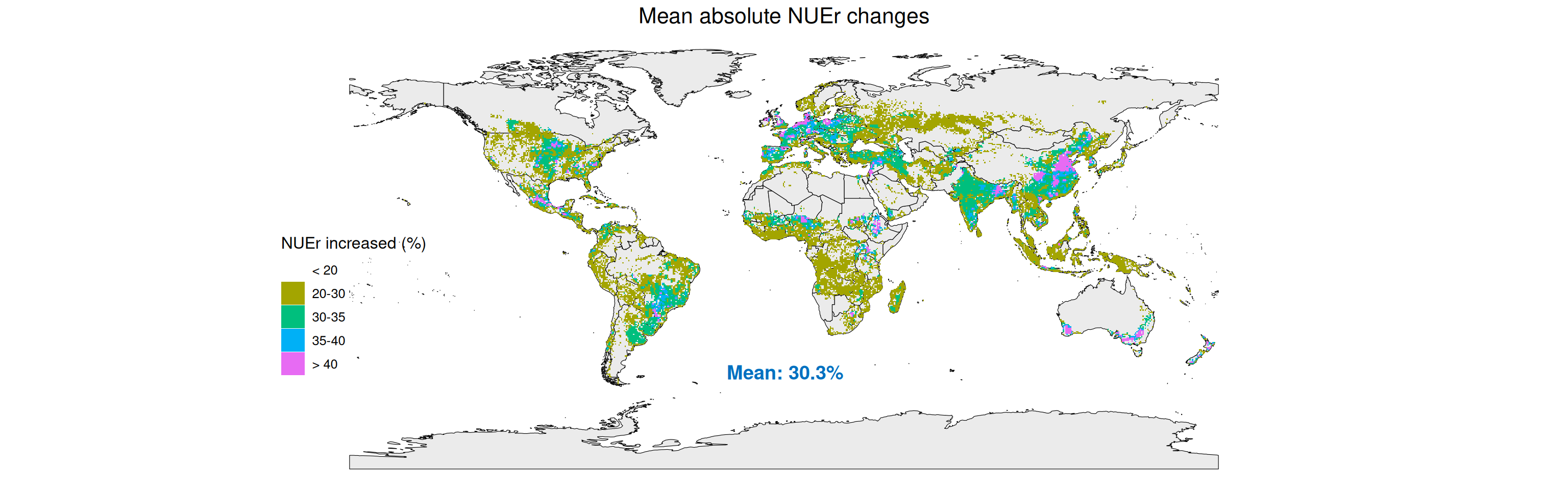
########################################### scenario_4 (combined_mean) ######################################################### set themetheme_set(theme_bw())# get the raster to plot r4 <- terra::rast('Figure/tif/scenario_4.tif')# convert to data.frame r4.p <-as.data.frame(r4,xy=TRUE)# get base world map world <-ne_countries(scale ="medium", returnclass ="sf")# plot a basic world map plot p4 <-ggplot(data = world) +geom_sf(color ="black", fill ="gray92") +geom_tile(data = r4.p,aes(x=x,y=y, name ='none',fill =cut(improvement,breaks=c(0,20,30,35,40,800),labels =c('< 20','20-30','30-35','35-40','> 40') ))) +theme_void() +theme(legend.position =c(0.05,0.4), text =element_text(size =12),legend.background =element_rect(fill =NA,color =NA),panel.border =element_blank()) +scale_fill_manual(values =c("#FF7F50","#a3a500", "#00bf7d", "#00b0f6","#e76bf3"),drop=FALSE)+labs(fill ='NUEr increased (%)') +xlab("Longitude") +ylab("Latitude") +ggtitle("Mean absolute NUEr changes") +theme(plot.title =element_text(size =16))+theme(plot.title =element_text(hjust =0.5))+annotate("text",x=0.5,y=-50,label="Mean: 30.3%",size=5, colour="#0070C0",fontface ="bold")+coord_sf(crs =4326)
Warning in geom_tile(data = r4.p, aes(x = x, y = y, name = "none", fill =
cut(improvement, : Ignoring unknown aesthetics: name
Warning: A numeric `legend.position` argument in `theme()` was deprecated in ggplot2
3.5.0.
ℹ Please use the `legend.position.inside` argument of `theme()` instead.
p4
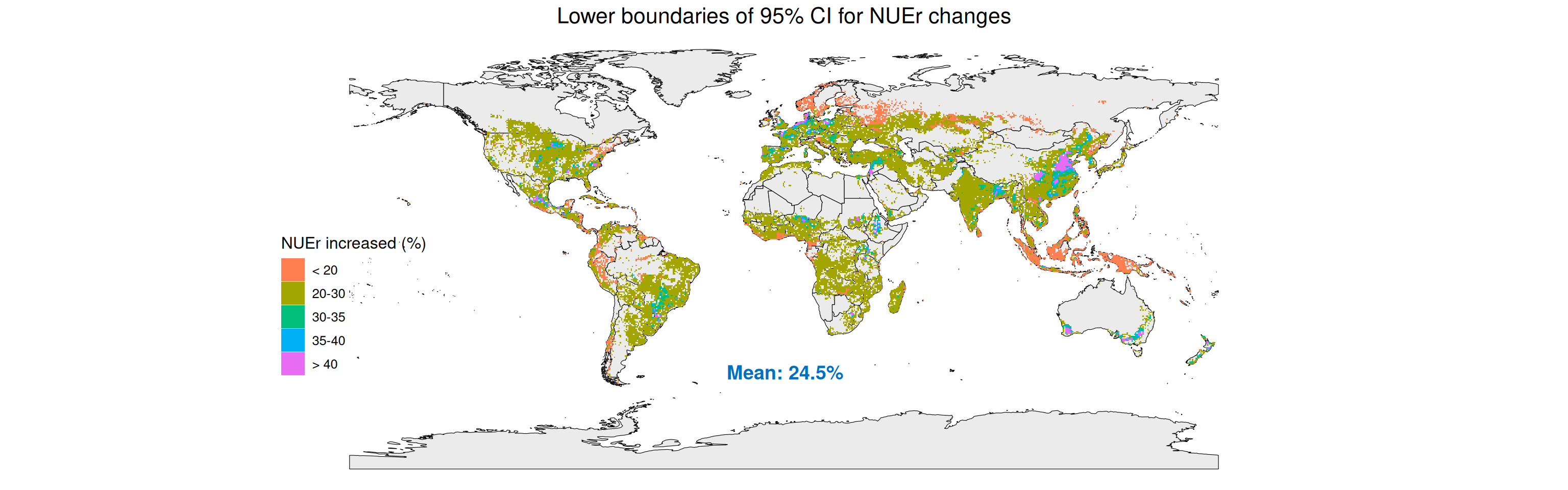
########################################### scenario_5 (combined_lower boundary) ######################################################### set themetheme_set(theme_bw())# get the raster to plot r5 <- terra::rast('Figure/tif/scenario_5.tif')# convert to data.frame r5.p <-as.data.frame(r5,xy=TRUE)# get base world map world <-ne_countries(scale ="medium", returnclass ="sf")# plot a basic world map plot p5 <-ggplot(data = world) +geom_sf(color ="black", fill ="gray92") +geom_tile(data = r5.p,aes(x=x,y=y, name ='none',fill =cut(lower_improvement,breaks=c(0,20,30,35,40,800),labels =c('< 20','20-30','30-35','35-40','> 40') ))) +theme_void() +theme(legend.position =c(0.05,0.4), text =element_text(size =12),legend.background =element_rect(fill =NA,color =NA),panel.border =element_blank()) +scale_fill_manual(values =c("#FF7F50","#a3a500", "#00bf7d", "#00b0f6","#e76bf3"),drop=FALSE)+labs(fill ='NUEr increased (%)') +xlab("Longitude") +ylab("Latitude") +ggtitle("Lower boundaries of 95% CI for NUEr changes") +theme(plot.title =element_text(size =16))+theme(plot.title =element_text(hjust =0.5))+annotate("text",x=0.5,y=-50,label="Mean: 24.5%",size=5, colour="#0070C0",fontface ="bold")+coord_sf(crs =4326)
Warning in geom_tile(data = r5.p, aes(x = x, y = y, name = "none", fill =
cut(lower_improvement, : Ignoring unknown aesthetics: name
p5
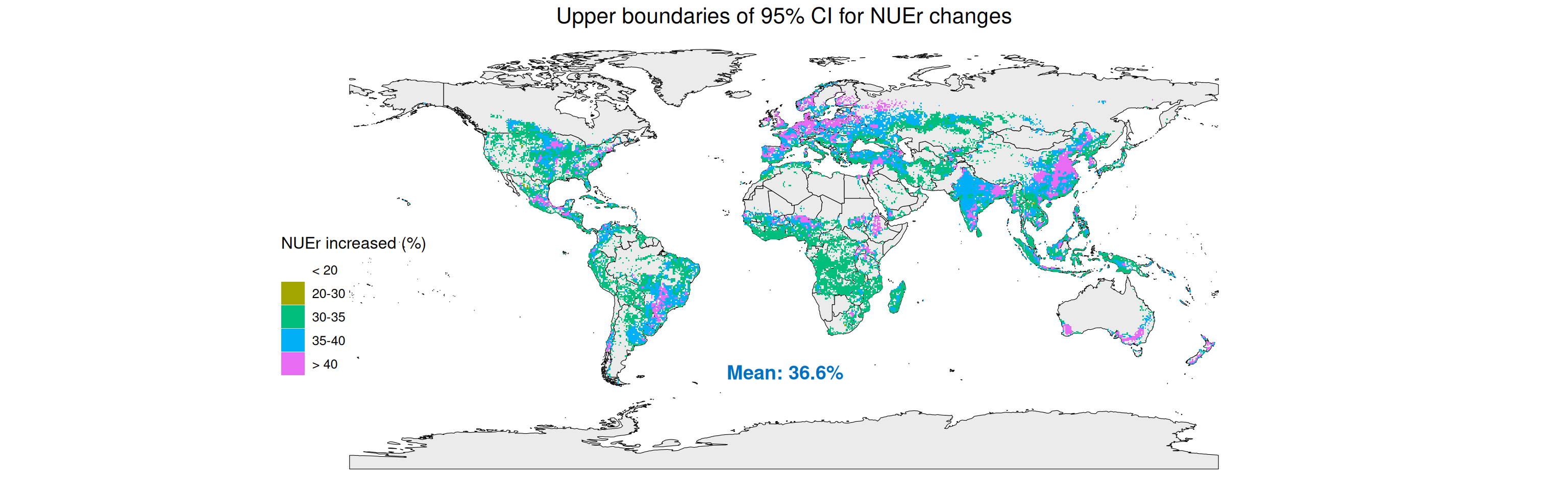
########################################### scenario_6 (combined_lower boundary) ######################################################### set themetheme_set(theme_bw())# get the raster to plot r6 <- terra::rast('Figure/tif/scenario_6.tif')# convert to data.frame r6.p <-as.data.frame(r6,xy=TRUE)# get base world map world <-ne_countries(scale ="medium", returnclass ="sf")# plot a basic world map plot p6 <-ggplot(data = world) +geom_sf(color ="black", fill ="gray92") +geom_tile(data = r6.p,aes(x=x,y=y, name ='none',fill =cut(upper_improvement,breaks=c(0,20,30,35,40,800),labels =c('< 20','20-30','30-35','35-40','> 40') ))) +theme_void() +theme(legend.position =c(0.05,0.4), text =element_text(size =12),legend.background =element_rect(fill =NA,color =NA),panel.border =element_blank()) +scale_fill_manual(values =c("#FF7F50","#a3a500", "#00bf7d", "#00b0f6","#e76bf3"),drop=FALSE)+labs(fill ='NUEr increased (%)') +xlab("Longitude") +ylab("Latitude") +ggtitle("Upper boundaries of 95% CI for NUEr changes") +theme(plot.title =element_text(size =16))+theme(plot.title =element_text(hjust =0.5))+annotate("text",x=0.5,y=-50,label="Mean: 36.6%",size=5, colour="#0070C0",fontface ="bold")+coord_sf(crs =4326)
Warning in geom_tile(data = r6.p, aes(x = x, y = y, name = "none", fill =
cut(upper_improvement, : Ignoring unknown aesthetics: name